
Morden & St Helier, A Short History
Morden, in the London Borough of Merton (postcode SM4), began as a small rural village surrounded by farmland. It is recorded in the Domesday Book of 1086 as part of an agricultural estate, and for centuries it remained a quiet area focused on farming and country estates, including Morden Hall.
Originally much of the land in Morden was owned by the church and sold to the Garth Family, who founded Morden Hall Park with its famous rose gardens and which is maintained today by the National Trust and is Morden’s best, ‘worst kept’ secret!
Morden’s contemporary history is very much tied in with the event of its underground station as Morden became the southern terminus of the Northern line, triggering rapid suburban development. Fields were replaced with housing, shops, and new roads, turning Morden into a key commuter town.
With the local census count showing approximately 600 residents in 1801 by 1920 Morden’s populace still hadn’t reached over 1500. This is compared to nearby Wimbledon which grew from 1500 inhabitants to over 42,000 in the same period
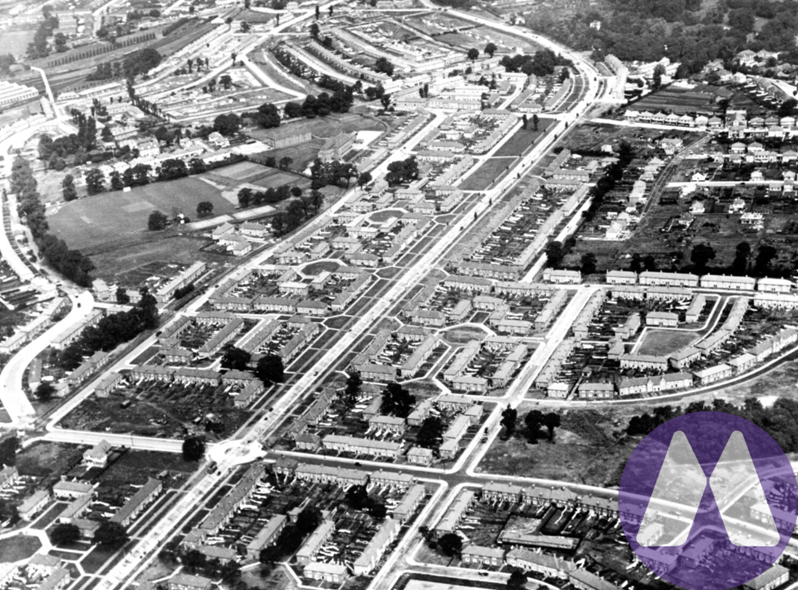
However from the 1930s Morden thrived, with a Cinema, Public Houses and Departments stores all opening up to cater to the new residents. The main driver of this was the St Helier estate, which was one of the largest social housing estates when built.
The estate was commissioned by London County Council (LCC) to re-house people from overcrowded inner-London areas post, First World War, and land acquisition began around 1926 – 1929 with the main building phase being from 1928-1936.
From the outset its aim was to encourage healthier living with generously spaced homes and lots of green space, the landscape design being mastermind by designer, Edward Prentice Mawson, reflecting “garden city” ideals. These aims are still clearly evident today with the front and rear gardens, and cul-de-sac’s based around open green spaces properties bounded by trees and hedgerows and access to public parks and recreation.
In recognition of the land’s historic association with Westminster Abbey; the road names are named after monasteries and abbeys and run in alphabetical order, (north-west to south-east) which is why you may often find estate agents talking about Morden’s ‘A and B roads’ being popular as they are closest to the underground Station, though there are excellent transport links with regular bus services serving much of the estate.
In the 1960s Crown House was built, originally as an office development with a postal sorting office and shops at ground level and was named after the former historic Crown House pub that stood on the lad. By 1985, Merton Borough Council has transferred much of its departmental offices from Wimbledon Town Hall and as of 1990 with further works to the front of the building to create a library and heritage centre the building officially became the Civic Centre for Merton.
From the 1970’s and the introduction of the right to buy scheme, many properties on the St Helier Estate became privately owned and along with that, came permissions to covert lofts, build extensions etc, making it more of the housing development that we know today.
However nearly 100 years on, since the initial development of the St Helier Estate, not a huge amount has actually change in terms of housing stock, which is what makes the area so popular as there is very few new developments and no high rise developments.
Regeneration of the area has often been touted, and was last seriously on the cards in 2016 -2020 before the Covid pandemic struck.
Recently, Merton Council has announced a 30million pound investment plan and with 2026 seeing 100 years SINCE Morden underground being built, Morden is sure to attract attention once again.